
English
LS-CR Thermal Break Cleanroom Wall System
Nov 27, 2026
Published: 11/27/2026 | Category: cleanroom panel system
Line-Link is highlighting the "LS-CR thermal break wall system", an integrated cleanroom enclosure solution engineered to reduce thermal bridging at panel-to-panel connections and support cleanroom condensation control.
Even when cleanroom sandwich panels feature an insulated core, continuous metal connections between inner and outer skins can create local cold spots where moisture condenses. The LS-CR system addresses this vulnerability by using "PVC edge profiles and connecting components" to separate the metal faces and interrupt direct conductive heat transfer.
## LS-CR System at a Glance
| Attribute | System Details |
| "Product Name" | Line-Link LS-CR Thermal Break Wall System
| "Core Mechanism" | PVC edge profiles and connectors interrupt metal-to-metal conductive paths |
| "Panel Architecture" | Modular sandwich-panel construction with selectable surfaces and insulation cores |
| "Compatible Enclosure Items" | Cleanroom doors, observation windows, and ceiling systems |
| "Primary Applications" | Pharmaceutical, medical-device, and food-processing facilities |
## Product Features That Support Project Planning
The "LS-CR thermal break wall system" combines thermal-break joint construction with modular Line-Link cleanroom panels, allowing project teams to tailor surface finishes and insulation cores to specific room conditions.
Key planning considerations supported by the system include:
"Condensation Risk Mitigation:" Interrupts conductive heat paths at panel joints where temperature differentials across partitions are common.
"Application-Matched Materials:" Offers selectable panel finishes and insulation cores aligned with chemical cleaning, thermal insulation, and facility requirements.
"Integrated Enclosure Coordination:" Designed to interface cleanly with Line-Link cleanroom doors, observation windows, and ceiling systems.
"Pre-Construction Interface Review:" Supports early evaluation of joint details, penetrations, and assembly sequencing before site installation.
These capabilities are especially relevant for "pharmaceutical, medical-device, and food-processing facilities", particularly along partitions separating chilled rooms, high-humidity production zones, and unconditioned service areas.
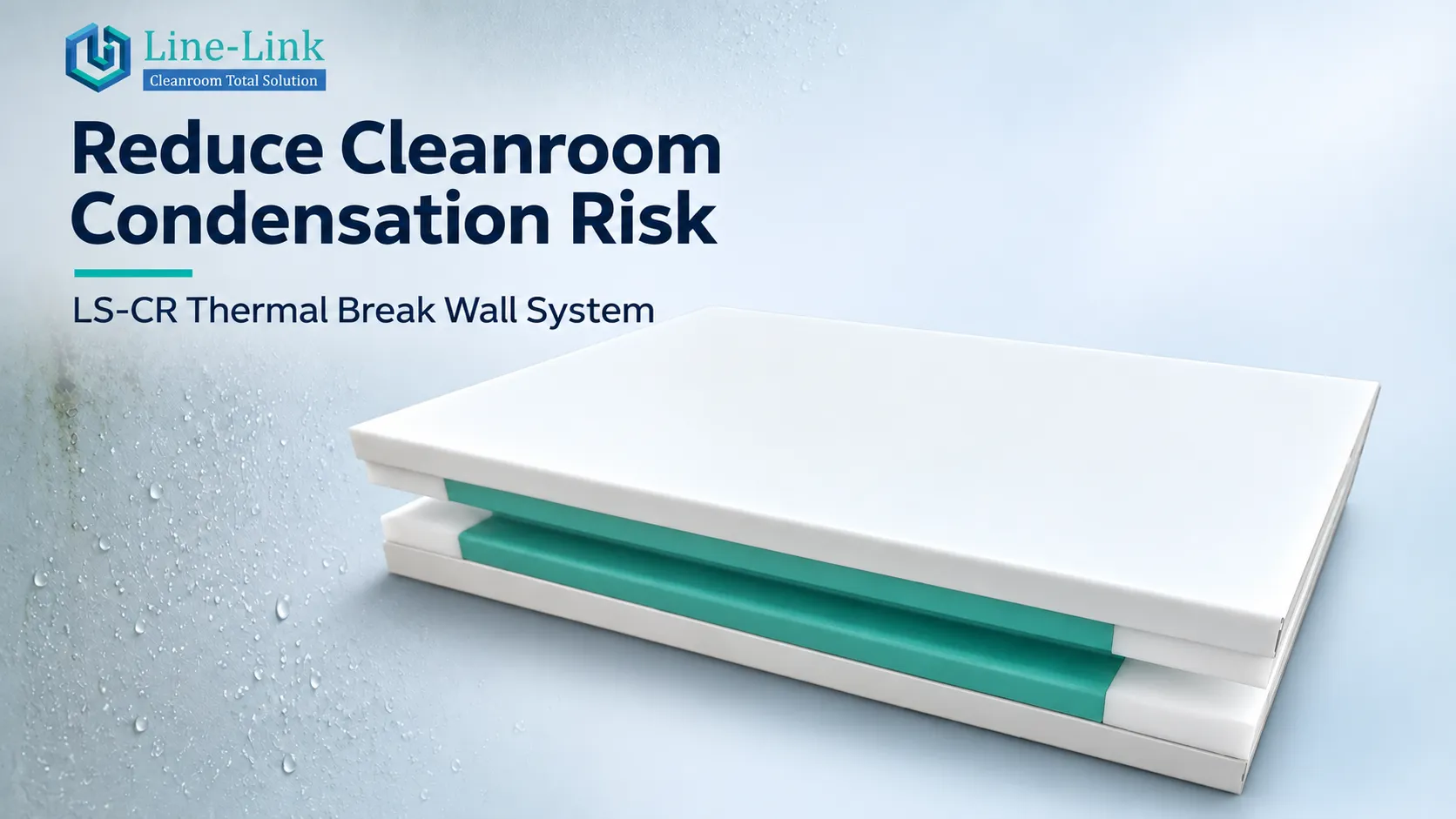
*Caption: Line-Link’s LS-CR wall system integrates thermal-break panel joints with doors, windows, and ceiling assemblies.*
## From Individual Panels to an Integrated Cleanroom Enclosure
Effective "cleanroom condensation control" depends on reviewing the entire enclosure rather than a single component in isolation. While thermal-break panel connections reduce conductive heat transfer at the seam, overall performance still relies on ambient temperature, relative humidity, airtight sealing, adjoining frames, and installation quality.
Line-Link supports projects from component supply through engineering coordination, helping teams review joints, door frames, and utility penetrations together as a complete system.
For a deeper technical breakdown of how thermal bridges form and how PVC connections mitigate them, read our companion blog: [Why Do Cleanroom Walls Condense? Inside Line-Link’s LS-CR Thermal Break System]
## Discuss Your Cleanroom Project with Line-Link
Planning a new facility or upgrading an existing "cleanroom enclosure"? Explore [Line-Link’s cleanroom solutions] or send your room layout and operating conditions to "frank@linelink-linsen.com" to connect with our engineering team.
Recent Posts

October 26, 2016
The Most Successful Engineering Contractor


Sep 14, 2026
Visit Line-Link®at CPHI Milan 2026
May 14, 2026
Line-Link® at WAPHC Show 2026
May 14, 2026
Line-Link® Meet you at CPHI China 2026Contact US
Product Information
Quantity
Unit
Piece
Support order samples, customization, wholesale direct, and complete payment. If the product you look for does not have corresponding customized content, pls fill out the form below to contact us, and we will reply ASAP.